What "precision" means in a bearing specification
Precision is not a marketing word here — it refers to a specific ISO 492 tolerance class. Standard bearings are class P0 (also written Normal). Precision grades run P6, P5, P4 and P2, each tightening the permitted deviation on bore, outside diameter, width and running accuracy.
The practical consequence is runout. A P4 bearing holds the shaft closer to true rotation than a P0 bearing, which matters enormously on a grinding spindle and not at all on a conveyor idler.
Precision versus standard: where the difference shows
| Factor | Standard (P0) | Precision (P5 / P4) |
|---|---|---|
| Radial runout | Higher permitted deviation | Substantially tighter |
| Speed capability | Adequate for general duty | Higher — less heat from imbalance |
| Vibration | Acceptable for most machinery | Markedly lower |
| Cost | Baseline | Typically 2 – 5× baseline |
| Correct application | Motors, conveyors, pumps, fans | Machine tool spindles, high-speed rotors, metrology |
Choosing bearing type by load condition
Tolerance class is one axis of the decision. Bearing type is the other, and it is driven by the load and alignment condition.
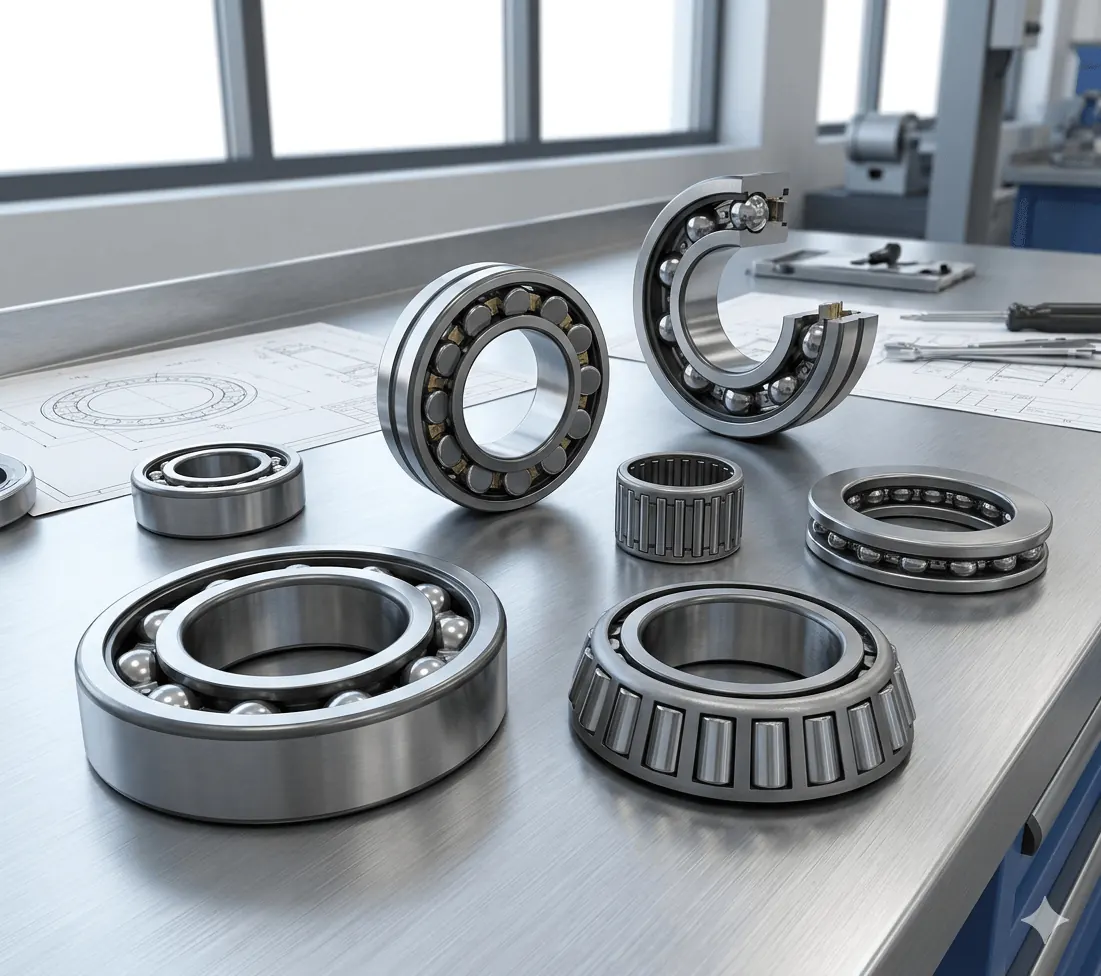
- Deep groove ball. Moderate radial load with some axial capacity. The default for electric motors and general machinery.
- Angular contact. Combined radial and one-directional axial load. Used in pairs for spindles.
- Spherical roller. Very high radial load with several degrees of static misalignment tolerance. The standard choice for crushers, screens and long conveyor shafts.
- Tapered roller. Heavy combined radial and axial load. Common in wheel hubs and gearboxes.
- Needle roller. High radial load in a restricted radial envelope.
- Thrust. Pure axial load.
Sand ingress: the dominant failure mode in the Gulf
Across the customers we supply in the UAE, abrasive dust contamination causes more premature bearing failure than overloading, misalignment and lubrication faults combined.
Fine silica passes shields readily, scores the raceway and contaminates the grease into a lapping compound. The bearing then destroys itself through a wear mechanism that has nothing to do with its load rating.
Two countermeasures matter more than any bearing upgrade: specify 2RS contact seals rather than ZZ shields on exposed positions, and shorten regreasing intervals in dusty environments. Both are cheap relative to an unplanned shutdown.
Clearance selection
Internal clearance is specified separately from tolerance class. CN (normal) suits most applications. C3 — greater than normal — is specified where the inner ring runs hot relative to the outer, because thermal expansion consumes clearance in service. Bearings in hot applications fitted with CN clearance can preload themselves to failure.
Our full range and interchange lookup is on the industrial bearings page.
Common questions
Is a precision bearing always better than a standard one?
No. Precision classes cost several times more and deliver benefit only where runout, speed or vibration is critical. On conveyors, fans, pumps and standard motors, P0 is the correct engineering choice, not a compromise.
Which bearing suits high radial load with shaft misalignment?
A spherical roller bearing. Two rows of barrel rollers run on a common spherical raceway, accommodating several degrees of static misalignment while carrying very high radial load.
What does C3 clearance mean and when do I need it?
C3 is greater-than-normal internal clearance. Specify it where the inner ring runs significantly hotter than the outer, since thermal expansion consumes clearance in service. Using CN in a hot application risks self-preloading.
Do you cross-reference SKF, FAG and NSK part numbers?
Yes. Provide your existing part number and we return the genuine item where available plus dimensional equivalents across the major manufacturers, with clearance and cage type stated so the comparison is like for like.
Need help selecting the right specification?
Send the application, the part you use today or a photo. We’ll recommend the right grade and quote it line by line.