What a certified high-pressure hydraulic hose actually is
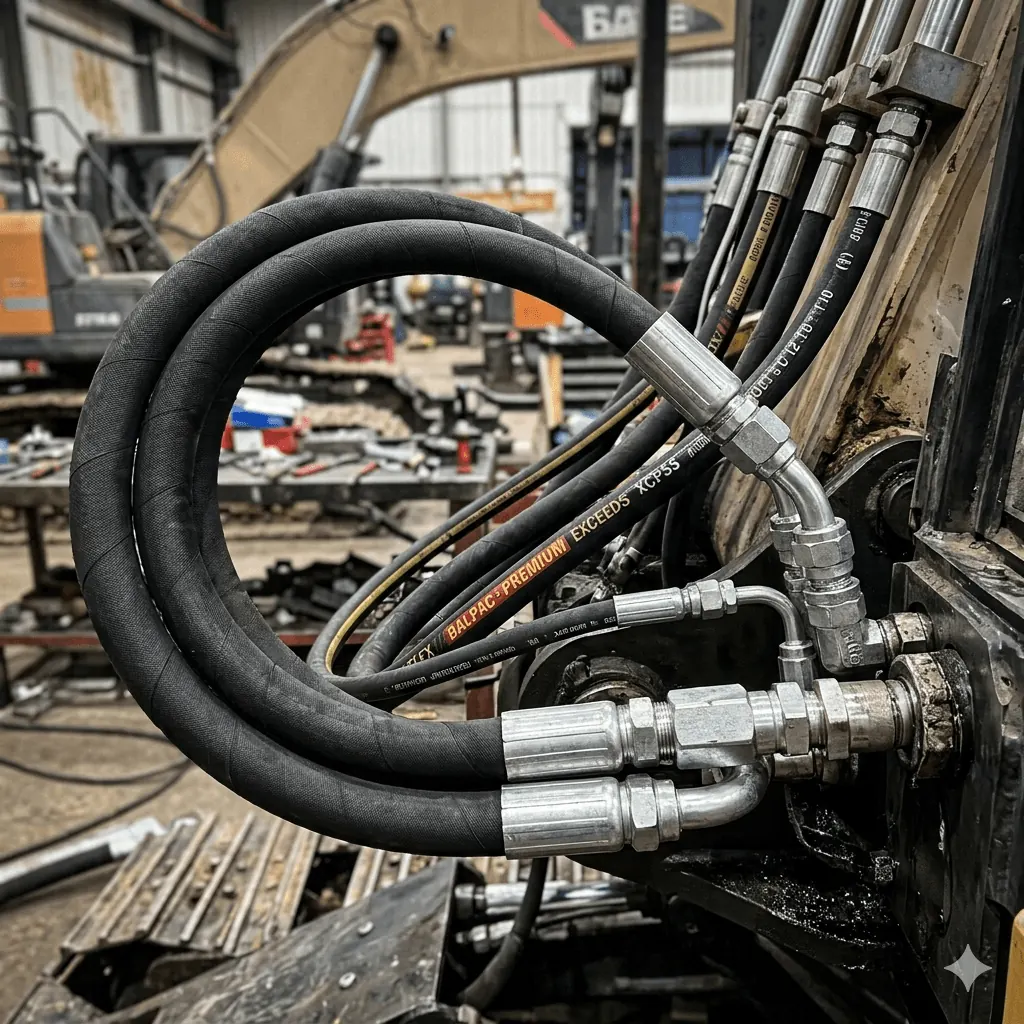
A hydraulic hose is a layered assembly, and each layer has one job. The inner tube contains the fluid and must be chemically compatible with it. The reinforcement — wire braid or spiral wound — carries the pressure. The outer cover protects the reinforcement from abrasion, ozone and UV.
Certification means the assembly has been manufactured and tested to a published standard: EN 853 for braided, EN 856 for spiral, or the SAE 100R series. The standard fixes minimum burst pressure at four times working pressure and specifies an impulse cycle count the construction must survive.
Wire-braided versus spiral-reinforced
This is the decision that determines whether an assembly lasts years or months, and it is frequently made on price instead of duty cycle.
| Property | Wire braided (1SN / 2SN) | Spiral reinforced (4SP / 4SH / R12) |
|---|---|---|
| Reinforcement | One or two crossed braid layers | Four or six alternating wound layers |
| Working pressure | Up to ~400 bar (small bore) | Up to 420 bar sustained at larger bore |
| Impulse resistance | Moderate | High — designed for surge cycling |
| Flexibility | More flexible, tighter bend radius | Stiffer, larger minimum bend radius |
| Best for | Steady pressure, frequent flexing | Shock loading, high-cycle impulse duty |
The short version: if the circuit sees pressure spikes or reversing loads, specify spiral. If it flexes constantly at steady pressure, braided will outlast spiral because it tolerates the movement.
Why hoses fail early in UAE conditions
Gulf operating conditions attack hydraulic hose in ways temperate-climate design assumptions do not anticipate.
- Thermal hardening. Sustained ambient above 45 °C, combined with fluid temperature, drives the inner tube past its design range. The elastomer hardens, loses elasticity and cracks at the next pressure cycle.
- Bend radius violation. Routing a hose tighter than its minimum radius concentrates stress on the outer reinforcement wires. This is the most common installation error and it is entirely avoidable.
- Pressure surge. Rapid valve closure generates spikes well above nominal working pressure. Rated impulse cycles are consumed far faster than the operator realises.
- UV and sand abrasion. Exposed runs lose cover integrity, wire begins to corrode, and burst follows. Spiral guard or sleeving on exposed sections is cheap insurance.
A replacement policy that works
Most manufacturers recommend replacing hydraulic hose every five to seven years from the date of manufacture regardless of visual condition — the layline carries that date, and it is worth recording at installation.
Replace immediately, without waiting for a scheduled interval, on any of the following: cover cracking or blistering, any wire visible through the cover, weeping or seepage at the ferrule, kinking or crushing, or a fitting that has begun to corrode.
Specifying a replacement assembly
To build a correct replacement we need bore size, overall length, both fitting types and their orientation relative to each other, and the working pressure. If you have the failed assembly, bring it — we take the dimensions directly and remove the guesswork.
Assemblies are crimped and proof-tested in house, with test certificates supplied on request. Standard configurations are generally ready the same working day. See our hydraulic hoses and fittings page for the full range.
Common questions
How often should hydraulic hoses be replaced?
Every five to seven years from the manufacture date printed on the layline, regardless of appearance — and immediately on any sign of cover cracking, wire exposure, blistering or ferrule weeping.
What causes thermal hardening of a hydraulic hose?
Sustained operation above the inner tube temperature rating. In the Gulf, high ambient plus fluid temperature routinely exceeds standard ratings. Specifying a higher-temperature construction addresses it directly.
Can I use a 2SN hose to replace a 4SP hose?
Not as a like-for-like substitution. 4SP is specified where impulse cycling or shock load is present, and a braided hose will not survive the same duty. Match or exceed the original construction.
Do you supply test certificates with hose assemblies?
Yes, on request. Assemblies are crimped and proof-tested in house, and we can provide documented test results for assemblies going into certified or audited installations.
Need help selecting the right specification?
Send the application, the part you use today or a photo. We’ll recommend the right grade and quote it line by line.