Cutting & Machining
Cutting Tools & CNC Tooling
- Tool types
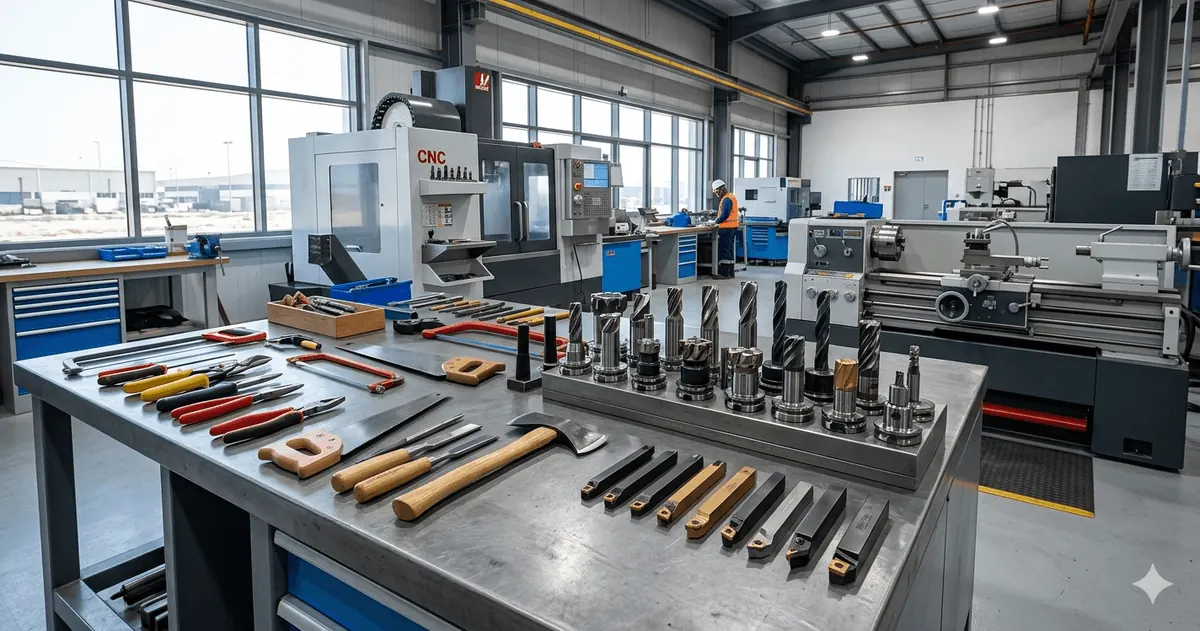
- End mills, drills, taps, reamers, indexable inserts, tool holders
- End Mills
- Drill Bits
- Taps & Dies
- Reamers
Industrial components & MRO supply · UAE & GCC
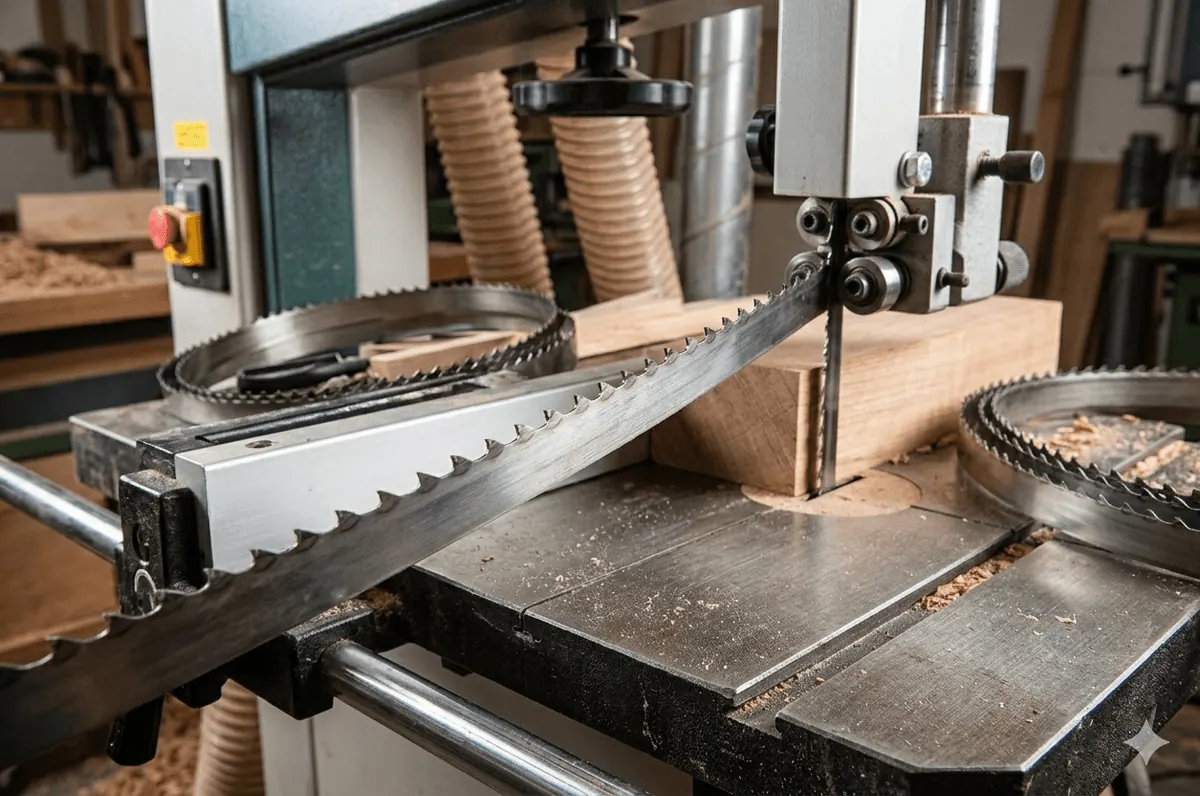 Product photograph · 1 / 5
Cutting & Machining · Precision Cutting
High-performance bandsaw blades for metal, wood and plastic cutting — welded to length in house, with selection advice based on your material, section size and machine.
Or call +971 56 620 2517 · Sun – Sat, 08:00 – 18:00 (GST)
A bandsaw blade is a continuous toothed steel band that runs between two wheels to make a cut. In metal cutting, bi-metal blades bond a high-speed-steel tooth edge to a flexible alloy backing, giving hard, wear-resistant teeth without making the whole blade brittle.
| Specification | Details |
|---|---|
| Blade types | Bi-metal M42 / M51, carbide tipped, carbon steel |
| Width range | 13 – 80 mm |
| Gauge | 0.65 – 1.60 mm |
| Tooth pitch | 2/3, 3/4, 4/6, 5/8, 6/10, 8/12, 10/14 TPI variable |
| Tooth set | Raker, wavy, alternate |
| Band length | 1 000 – 8 000 mm, welded to requirement |
| Materials cut | Structural steel, stainless, exotic alloys, aluminium, wood, plastics |
| Lead time | Welded to length same/next day from stock coil |
Ranges shown are what we typically supply. The exact rating, size and standard for your item are stated on the quotation.
Have an OEM or competitor part number? Send it and we will quote the genuine item where available alongside any equivalent, with dimensions and ratings stated so the substitution can be checked.
Bi-metal M42 covers most general fabrication on mild and structural steel at the lowest cost per cut. Move to carbide tipped for hardened steel, stainless above roughly 40 mm section, nickel alloys and titanium, where bi-metal teeth dull quickly. Carbide costs more per blade but usually reduces cost per cut on those materials.
Aim for three to six teeth engaged in the cut at all times. Thin wall tube needs a fine pitch such as 10/14 TPI to stop teeth stripping; heavy solid section needs a coarse pitch such as 2/3 or 3/4 TPI to clear the chip. Variable pitch blades reduce harmonic vibration and give a cleaner cut.
The usual causes are too coarse a pitch for the wall thickness, feed rate too high for the material, insufficient blade tension, or inadequate coolant flow. A new blade also needs breaking in at reduced feed for the first 50 to 100 cm² of cut area to hone the tooth tips.
Yes. We weld to length in house from stock coil, so any band length between roughly 1 000 and 8 000 mm is available. Provide the machine make and model, or the length, width and gauge of the existing blade.
Often sourced together
Cutting & Machining
Surface Treatment
Motion & Power Transmission
Send us the part number, specification, drawing or photo. Our team will help identify the right sourcing option.