How a bandsaw blade is constructed
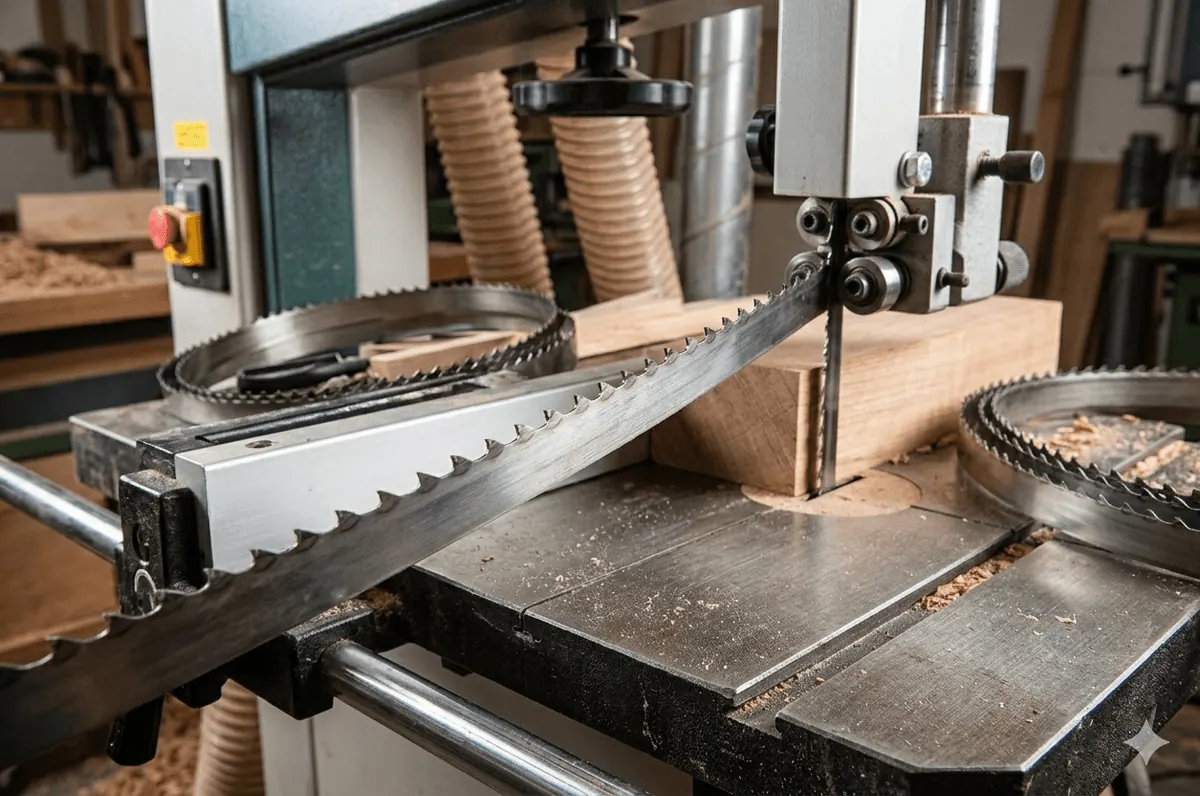
A bandsaw blade is a continuous toothed band running between two wheels. In metal cutting, the useful designs are composites: a hard cutting edge bonded to a flexible backing, so the teeth resist wear while the band survives millions of flex cycles around the wheels.
Bi-metal blades electron-beam weld an M42 or M51 high-speed-steel wire to an alloy steel backing, then form the teeth from the HSS edge. Carbide-tipped blades braze individual tungsten carbide tips to the backing instead.
Bi-metal versus carbide: the real comparison
| Factor | Bi-metal M42 / M51 | Carbide tipped |
|---|---|---|
| Blade cost | Baseline | 3 – 6× baseline |
| Mild / structural steel | Excellent — lowest cost per cut | Overspecified |
| Stainless above 40 mm | Teeth dull quickly | Substantially better life |
| Nickel alloys, titanium | Poor | The only practical choice |
| Cutting speed | Moderate | Higher surface speed sustainable |
| Shock tolerance | Better — more forgiving of interrupted cut | Tips chip on impact or vibration |
The decision is cost per cut, not cost per blade. On mild steel, bi-metal wins comfortably. On a production run of 60 mm stainless bar, a carbide blade costing five times more can still halve the cost per piece.
Tooth pitch selection
This is where most blade problems originate. The governing rule is simple: aim for three to six teeth engaged in the cut at all times.
- Too few teeth engaged and each tooth takes an excessive bite. Teeth strip, usually catastrophically and early in blade life.
- Too many teeth engaged and the gullets cannot clear the chip. Chips pack, heat builds, and the blade work-hardens the cut surface.
| Material section | Suggested pitch | Notes |
|---|---|---|
| Thin wall tube (< 3 mm) | 10/14 TPI | Fine pitch essential to avoid stripping |
| Tube and profile bundles | 6/10 or 8/12 TPI | Variable pitch reduces harmonic vibration |
| Solid bar 25 – 75 mm | 4/6 or 5/8 TPI | Most common general fabrication range |
| Heavy solid > 150 mm | 2/3 or 3/4 TPI | Coarse gullets needed for chip clearance |
Variable-pitch designations such as 4/6 mean the pitch alternates between those values along the band. This breaks up the harmonic vibration that causes chatter, giving cleaner cut squareness and quieter operation.
Why blades strip teeth
When a blade fails early, work through these in order — the cause is nearly always in this list.
- Pitch too coarse for the wall thickness or section being cut.
- Feed rate too high for the material — the blade is being forced rather than cutting.
- Insufficient blade tension, allowing the band to wander and twist in the cut.
- Inadequate coolant flow or wrong coolant concentration.
- No break-in period on a new blade.
Blade tension and coolant
Tension should be set with a tension gauge, not by feel — typically 250 to 300 N/mm² for bi-metal. Under-tensioned blades wander and produce out-of-square cuts; over-tensioned blades fatigue and crack at the weld.
Coolant does two jobs: it carries heat out of the cut and flushes chips from the gullets. In Gulf ambient conditions, check concentration weekly — evaporation concentrates the mix and changes its behaviour. We weld blades to length in house; see our bandsaw blades range.
Common questions
Should I use a bi-metal or carbide bandsaw blade?
Bi-metal M42 for general fabrication on mild and structural steel — it delivers the lowest cost per cut. Move to carbide tipped for hardened steel, stainless above roughly 40 mm section, nickel alloys and titanium.
How do I choose the right tooth pitch?
Keep three to six teeth engaged in the cut at all times. Thin wall tube needs fine pitch such as 10/14 TPI; heavy solid section needs coarse pitch such as 2/3 TPI to clear the chip.
Why do my bandsaw blades keep stripping teeth?
In order of likelihood: pitch too coarse for the section, feed rate too high, insufficient blade tension, inadequate coolant, or no break-in on the new blade.
Can you weld blades to a non-standard length?
Yes. We weld to length in house from stock coil, covering roughly 1 000 to 8 000 mm. Provide the machine make and model, or the length, width and gauge of the existing blade.
Need help selecting the right specification?
Send the application, the part you use today or a photo. We’ll recommend the right grade and quote it line by line.