Why arid-climate filtration is a different problem
Filter specifications are usually written against temperate-climate dust loading. Gulf conditions invalidate that assumption. Airborne particulate here is finer, more abrasive and present in far higher concentration, particularly during shamal wind events.
The consequence is not simply faster clogging. Fine silica that passes a coarse element reaches compressor screws, cylinder bores and turbine blades, where it acts as a lapping compound. The wear it causes is usually attributed to age rather than to filtration.
Filter types and what each one does
| Type | Removes | Typical position |
|---|---|---|
| Depth / pleated | Solid particulate through media thickness | Primary intake |
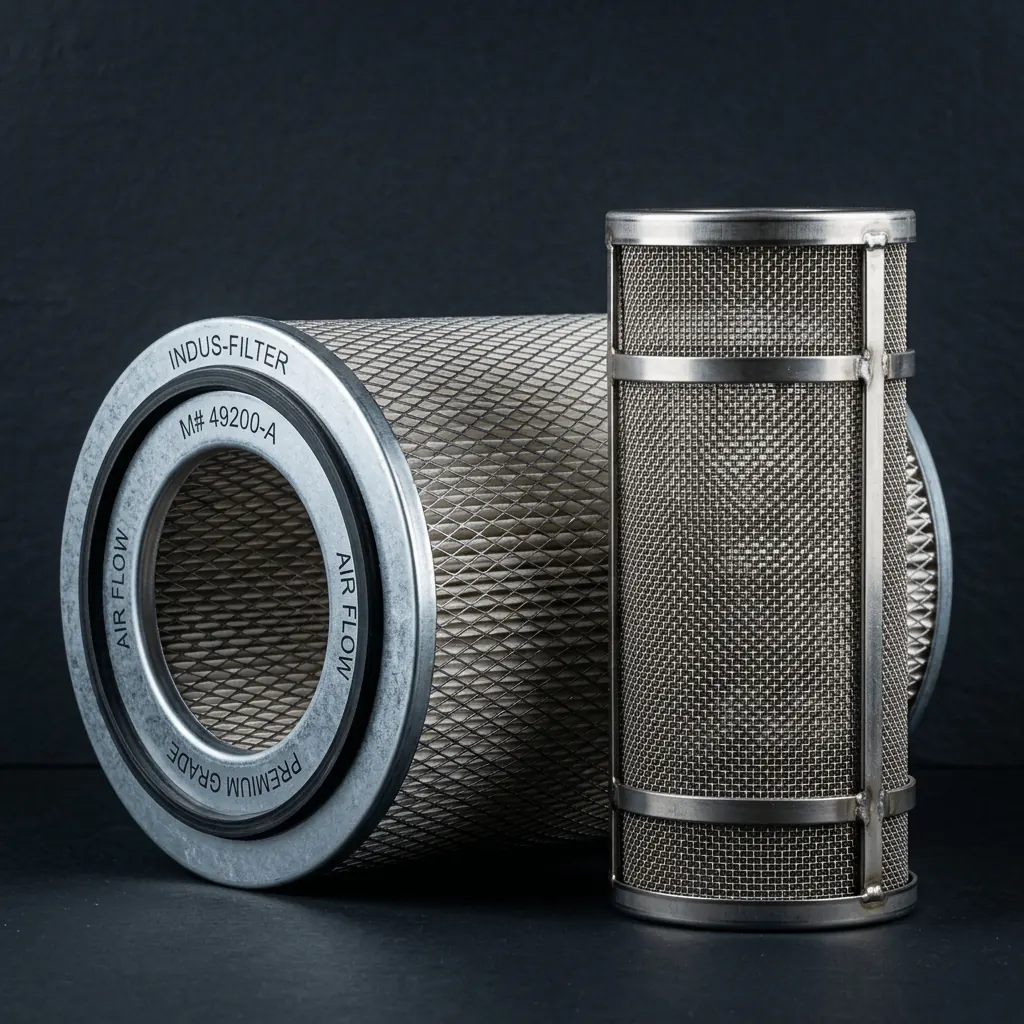
| Wire mesh | Coarse debris, insects, large particles | Pre-filter stage |
| Coalescer | Liquid aerosols — oil mist, water | Downstream of compression |
| Separator | Bulk liquid from air stream | Compressor discharge |
| Adsorption (carbon) | Vapour, odour, hydrocarbon | Final polish stage |
| Spin-on | Combined particulate and moisture | Compact inline installations |
Compressed air systems typically need several of these in sequence. Fitting a coalescer where a depth filter belongs, or vice versa, is a common and expensive specification error.
Understanding efficiency ratings
Two rating systems matter. ISO 16890 and the older EN 779 classes (G4 through F9) cover general ventilation. EN 1822 covers HEPA and ULPA classes (H13, H14) where fine particulate capture is critical.
For most industrial machine protection in the Gulf, a G4 pre-filter followed by an F7 to F9 primary gives the right balance. Jumping straight to a high-efficiency element without a pre-filter simply blinds the expensive stage quickly.
Setting replacement intervals correctly
Replace on differential pressure, not on hours. This is the single highest-value change most operations in this region can make to their filtration practice.
- Fit a differential pressure gauge across every primary intake filter.
- Record the clean-element pressure drop at commissioning as your baseline.
- Change the element when restriction reaches the manufacturer threshold — commonly 20 to 25 inches water gauge.
- Log the hours between changes. After three cycles you have a real interval for your site, not a generic one.
Operations that make this change typically find their genuine interval is two to three times shorter than the manufacturer default during dusty months, and roughly matches it in winter.
The cost of running a blinded filter
A restricted intake filter forces the machine to work against the restriction. On a rotary screw compressor, every additional inch of water gauge restriction costs measurable energy, and the pressure differential eventually collapses the element — at which point unfiltered air passes directly into the machine.
Element cost is trivial relative to a compressor airend rebuild. The economics of over-servicing filtration in this climate are not close. Our range and OEM cross-reference is on the industrial air filters page.
Common questions
How often should industrial air filters be replaced in the UAE?
Replace on differential pressure rather than calendar hours. Fit a gauge and change when restriction reaches the manufacturer threshold, typically 20 to 25 inches water gauge. In Gulf dust this often means intervals two to three times shorter than the default.
What is the difference between a depth filter and a coalescer?
A depth filter captures solid particulate through the thickness of its media. A coalescer merges liquid aerosols — oil mist or water — into droplets that drain out. Compressed air systems usually need both, in sequence.
Does sand ingress justify upgrading filtration grade?
In most Gulf installations, yes. Fine silica passes standard coarse elements and reaches compressor screws, cylinder bores and turbine blades. Upgrading the primary stage and adding a pre-filter is almost always cheaper than the wear it prevents.
Can you cross-reference an element from an OEM part number?
Yes. Provide the OEM element number or the housing make and model and we return a matching element with dimensions, micron rating and gasket type stated so you can confirm fit before ordering.
Need help selecting the right specification?
Send the application, the part you use today or a photo. We’ll recommend the right grade and quote it line by line.